On Monday morning a project director receives a progress summary from three construction sites. AI reads the reports in a few minutes and flags the site that is likely to slip. When the client asks whether the handover date will hold, though, he still has to call the site manager, check on materials, work out which tasks can be resequenced, and then make a commitment his team can actually deliver.
Summarising is now much faster than it used to be. That puts a manager's value in the steps that remain: what they check, how they decide, and how they bring the team along with the decision.
Workers in Viet Nam are in occupations with tasks that may be affected by generative AI, according to a 2026 ILO estimate. The ILO considers changes to tasks within jobs more likely than jobs disappearing outright. [1]
For business leaders the immediate question is a practical one. As the way work gets done changes, who on the team can take on the harder parts, and does the company already know their names?
Three familiar worries for leaders
01We hire good people, and within a year they are gone. Some stay only a few months.
02We pay well and still cannot find talent, while the people who do deliver leave for other companies.
03HR is busy all day with administration, and nobody looks after developing people.
Each worry has its own causes, but they usually meet at one point: the company has never agreed on what talent means. Without a shared definition, managers cannot tell whom to look for, whom to give the hard problems to, or whom to keep first. The more summarising work AI takes over, the more visible this gap becomes, because strong performers and people who simply get by no longer differ in how fast they produce a report.
The talent formula
Dave Ulrich writes talent as a product: Competence × Commitment × Contribution. Because the factors are multiplied, one factor close to zero pulls the whole result close to zero. A highly capable person who does not want to stay will leave in the middle of a project. A dedicated person without the competence works hard for little result. Someone with both who sees no meaning in the work will sooner or later lose their spark.
51/100 talent value
All three factors are fairly good. Pull one down to see the whole result change.
AI has its biggest effect on competence. Someone who knows the work and uses AI can weigh more options, learn faster and spot problems earlier. The more they rely on AI for speed, the more expertise they need to notice when an answer sounds convincing but rests on missing data.
AI cannot create commitment or contribution. Those come from how a manager assigns work, gives recognition and opens up opportunities. Every department head should ask: is my best person working on a problem important enough to make the work feel meaningful?
Pay opens the door; the leader is the steward who keeps people
Some companies have done everything right on policy: competitive pay, good benefits, clear bonuses. Their best people still leave after a year or two. In my years in HR I have found that people rarely leave over pay or benefits; far more often they leave because of their direct leader. A Gallup study of 7,272 U.S. adults found that one in two had left a job at some point to get away from their manager. [3]
Pay and benefits are the hardware. They help a company attract good people and remove income as a reason to leave, but they are not enough to make people want to stay and give their best. That part sits in the leader's emotional intelligence: the mood they bring into every meeting, the everyday working environment, and the authority talented people are given to use their full ability. Many leaders assume the pay is enough and forget their role in keeping the fire alive.
A leader's experience is one of the company's most valuable assets. Trouble starts when that experience hardens into a mould: every new idea is measured against how things were done before, and anything different is pushed aside. A reasoned "no", said with respect, can push people to think harder and do better. The same "no", repeated often and delivered with imposing emotion, narrows the listener's thinking until they no longer dare to propose anything and keep their opinions neutral. That is the first sign of quiet endurance, and it lays the foundation for Talent to leave.
The hard part is that leaders rarely notice. People still attend every meeting and finish every task; they have simply stopped speaking up. When a strong performer finally resigns, the file says "not a good fit", while the misfit was created on the leader's side. That is the blind spot.
Pay and benefits help a company attract talent. Keeping talent is the leader's job.
Three questions a leader can ask themselves
- How many proposals from my team did I turn down last week, and did I explain why each time?
- What can my best person decide without asking me?
- When did someone last challenge me in a meeting, and how did I react?
Four groups in the talent pool
In my talent management training material, I divide a company's talent pool into four groups. Each group includes people at every job level, and none of them is defined by age.
 SuccessorSuccessors
Selected and prepared to take over a key management position when needed.
 HIPOHigh potentials
Able to take on a bigger role than today and should be stretched early.
 TalentHigh performers
Consistently exceed expectations in their current role.
 Hot skillScarce skills
Deep expertise at level L4 or above; hard to hire and hard to replace.
Separating the groups makes policy clearer. Successors need a development path and a mentor. People with scarce skills often do not want to manage; they need an expert career ladder and pay close to the market rate. Putting everyone on one "talent" list under a single policy usually means the company keeps one group and loses another.
The talent and succession path from age 25 to 60
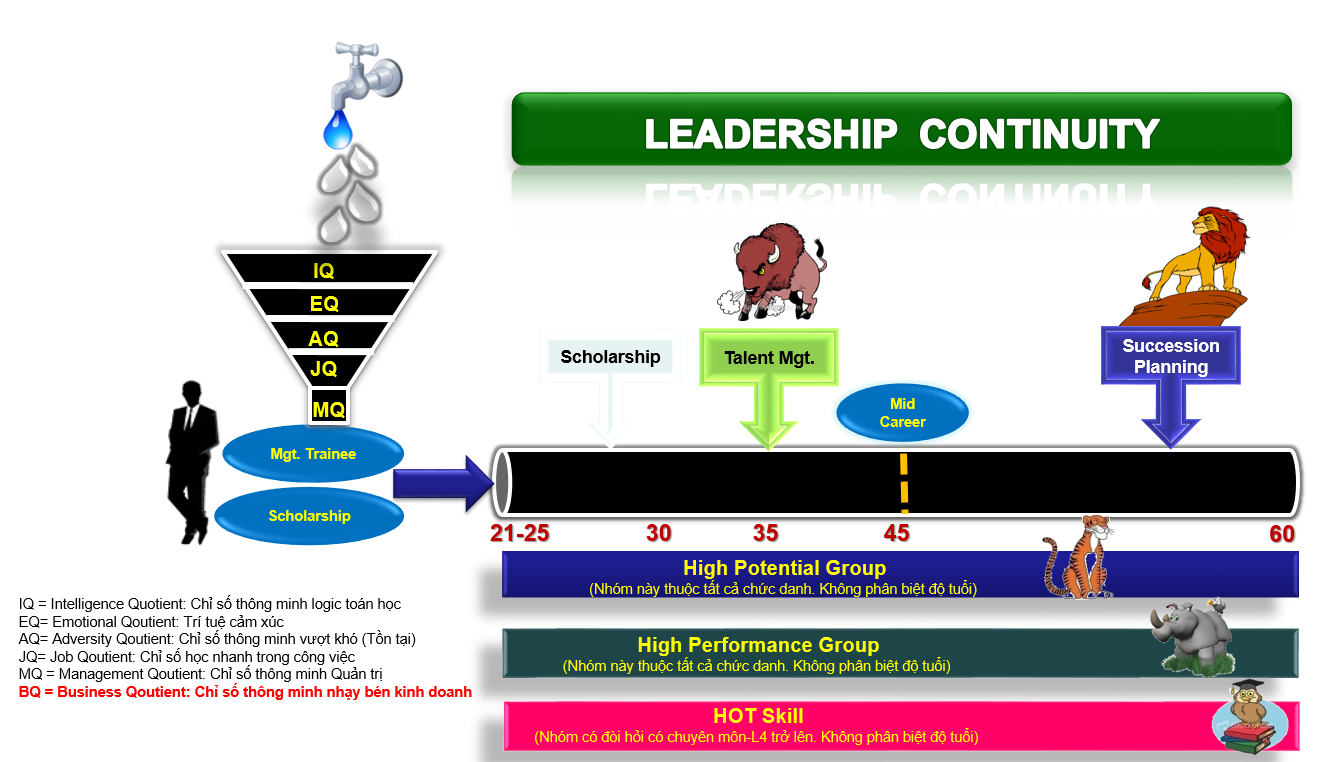
The Leadership Continuity diagram places these groups along one long path. Young people join the company at 21–25 through a management trainee programme or a scholarship. Before that, they pass through a filter of IQ (logical thinking), EQ (emotional intelligence), AQ (resilience), JQ (learning fast on the job) and MQ (management ability). The diagram also adds BQ, business acumen, in red.
Around age 35 the company brings people into its talent management programme. Age 45 marks mid-career, when it decides who moves on to leadership roles. Succession planning comes in the final stretch, before the current holder of a position retires. Running in parallel below are the three groups of high potentials, high performers and scarce skills, drawn from every job level and every age.
AI is changing the start of this path. Young people learn faster with AI tools, but the summarising and drafting work where they used to learn the trade is now done by machines. Unless companies redesign their stretch assignments, they will end up with many people who are fluent with AI and few who have ever made a difficult judgement on their own.
The nine-box grid: two separate questions
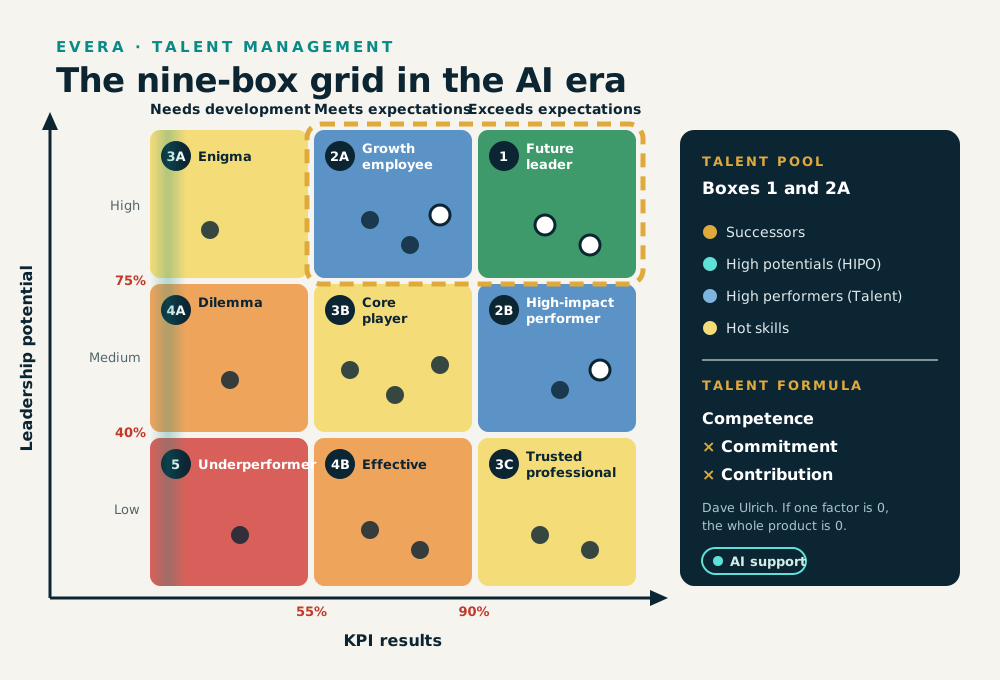
The nine-box grid places each person on two axes: KPI results across and leadership potential up. In my draft, the KPI thresholds are 55% and 90% and the potential thresholds are 40% and 75%. The number in each box is the investment priority, from box 1 to box 5. The company's talent group sits in boxes 1 and 2A.
Three points to watch when using the grid
- Ask the two questions separately: how are the results today, and can this person carry more responsibility? Merge them and people who do their current job well are easily misplaced among the high potentials.
- Rely on evidence from the work. An AI project shows quite clearly how someone learns, handles new situations and supports colleagues. When comparing people, check whether they had the same access to tools and data as everyone else.
- When someone lands in box 3A, review their position before drawing conclusions. High potential with low results often means the person is in the wrong seat or not yet a fit with their manager.
From using AI to improving work performance
Back to the site progress problem. The same task calls for different levels of AI use depending on each person's role.
An engineer uses AI to summarise site logs or draft the weekly report.
For a site manager, understanding the site and knowing how to verify an alert can matter more than building tools. For the person in charge of process improvement, competence means getting the whole team to use the solution consistently and proving that it catches problems earlier.
If AI moves toward artificial general intelligence (AGI), the range of work that can be handed to machines will widen further. Companies will still have to set their own goals and decide who holds decision rights and who answers for the results. Those capabilities can be built today, inside the processes that are already changing.
Start within 90 days
- Pick one critical role. Ask plainly: if nobody capable fills this position in the next six months, what grinds to a halt? It might be a project manager, or the only specialist who fully understands a key production line.
- Place the people who could fill that role on the nine-box grid. Use the latest KPI results and evidence from real work, score the two axes separately, then place each person in the right box of the grid.
- Give a stretch assignment with measurable results. For example, ask a promising engineer to pilot delay alerts on one site for 90 days, mentored by the site manager. At the end, look at how much earlier the team spotted problems, which alerts were missed and how the engineer handled conflicting data.
When I began drafting Talent Management in 2021, I wanted a handbook that would help companies find the right people, give them the right work and prepare successors. Continuing it today, I add one question for leaders: as AI takes over more of the summarising work, which problem will you give your best people so they keep growing with the company?
EVERA advisory programme
Talent management in the AI era
Who is talent in your company, where do you find them, how do you develop them, and what makes them stay? EVERA works with companies to answer those questions from their business goals and the real work of each role.
- Define talent
- Set out what talent means in each critical role, based on expertise, results, potential and the right level of AI use.
- Find and develop
- Identify internal potential, attract strong people from outside, and build development paths through real assignments, mentoring and succession.
- Keep strong people
- Design career paths, recognition and reward so strong people can see their future in the company.
- Turn contribution into added value
- Put the right people on important problems, give them suitable authority and bring AI into the process; measure results by quality, timeliness and value created.
EVERA's Talent Management module is being built to help companies run the programme, from competency profiles and performance and potential reviews to tracking development plans and succession readiness.

About the author
Phillip Le
Consultant in HR strategy, restructuring and organization development. He has held senior HR leadership roles at Vietnamese companies and multinational groups, with experience building HR systems, rolling out BSC/KPI and developing succession pipelines.
Reader perspective
Where do companies get stuck most?
I use real cases to choose the next topics for the book and to understand where companies need tool support.
Sources
- ILO. Generative AI could transform millions of jobs in Viet Nam (2026).
- Dave Ulrich, The RBL Group. A Talent Formula.
- Jim Harter, Amy Adkins, Gallup. Employees Want a Lot More From Their Managers (2015).
- Phillip Le. Draft and training material Talent Management and Career Path Design (2021).
Related article at EVERA: Designing Business Organizations in the AI Era.